
|
|
 |
Oi Articles Oi |  |
 Home |
Oi - About me - Oi |
Oi Oi - My Pixx - Oi Oi |
Oi - My Friends - Oi |
More fucking pixx |
Oi - ArTiCles - Oi |
Linxx Home |
Oi - About me - Oi |
Oi Oi - My Pixx - Oi Oi |
Oi - My Friends - Oi |
More fucking pixx |
Oi - ArTiCles - Oi |
Linxx |
|
this are just articles that i think are important.. Well people, some of this are just for you to entertain yourself. Some are pretty good and interesting, check them out and i'm sure that there's something you'll like or lear form it oh and by the way the fact that i ahve the bonehads history doesn't mean i support it, i hate boneheads, i hate racism in every way especially sinece i think we all should be united and racism divides us..^_^ |
||||
 Brotherhood |
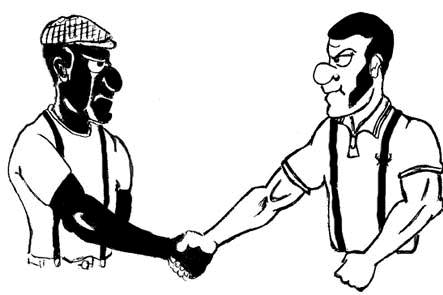
Some of the Skinhead history Skinhead culture emerged by 1969 in Britain out of the styles of white mod and black Jamaican rudeboy gangs and as a reaction against hippy values. It was a world of scooter rallies, ska and skinhead reggae, and football matches where there was more action among the spectators than on the field. Some did target South Asians and gays for violence, though apparently not to any greater degree than other kids of the time. A second wave of skinheads in the late seventies and early eighties came out of the punk scene, although ska retained its skinhead fans. A second wave of ska mixed ska rhythmes with punk organization of the scene and yielded such bands as Madness, Selecter, and The Specials. Streetpunk bands with a skinhead following were labelled Oi by a music writer Gary Bushell, from a Cockney exclamation abundantly used in the songs of the Cockney Rejects, one of the first and best of the bands. According to the record sleeves, oi was a working class reaction against the art students who had overrun the punk scene. Some of the other oi! bands of the time were The Oppressed, The Business, Sham69, Cock Sparrer, Blitz, Last Resort, Condemned84 and Combat84.
Baldies & Boneheads in America The skinhead subculture had already taken root in the U.S. by 1977, where it was viewed as a dramatic but not particularly political variant of punk. There were Black and Latin and Jewish skins, many of whom hung together in the bi-racial 2-Tone bands. The style "stood for unity," said James DePasquale, 18, who became a skinhead four years ago. "Everybody who had a shaved head, you considered them a brother," he said in the May/June '89 issue of the Utne Reader. With the help of fascists like Bob Heick, leader of a national Nazi youth group called The American Front, fascism also took root in American by 1985, when Nazi skinhead violence exploded at Haight-Ashbury in San Francisco that summer. "There were always idiots," says Tim Yohannan, editor of Maximum Rocknroll. "Now there's idiots with ideology." Skinheads distinguished each other with the terms "baldies" for the leftist non-racist skinheads, and "boneheads" for the white- power Nazi skinheads. Boneheads had no music scene of their own to speak of, since Skrewdriver was never allowed into the United States, and domestic white-power bands were wooden amateurs who lacked broad appeal. So the bones crashed the punk clubs, sometimes taking a razor blade to the locks of a longhair or ripping an anti-racist button off a peace punk's shirt. As in Britain, American punks, skinheads, or "baldies" have fought back in cities like Chicago and Minneapolis, where punks and "ska" skins have joined forces for more direct action. In January, 1989, more than 150 anti-racist skins from at least ten cities came to Minneapolis to form an umbrella organization for the anti-racist skins scattered throughout North America. By the end of the weekend, "The Syndicate" had been organized, and future anti-racist activities were planned. The Twin Cities emerged as a center of anti-racist skinhead activity in 1987 when a group of baldies challenged the neo-Nazi White Knights. the White Knights were effectively driven out of Minneapolis by a campaign of physical confrontations that reduced the neo-Nazi group to a handful of die-hard white supremacists and their leader, a member of the Ku Klux Klan. The January Minneapolis skinhead gathering, while predominantly white, included African-American, Native American, Latino and Asian skinheads. The average age of participants was 19. Their passionate desire to clear the skinhead name is rooted in the belief that skinhead culture has something to offer all nationalities. While the question of racism has been pushed on the skinhead movement, the media seems to ignore what many skins consider equally important: the question of class. The skinhead movement quite explicitly places its hopes for the future of the united action of the working class. It is as much by addressing and twisting the class question as by appealing to racism that the neo- Nazis have been able to establish a beachhead among white working- class youth. There is a deeply felt contempt for the rich in some quarters of American society that can be tapped with either revolutionary class politics or the half-baked Nazism of a Tom Metzger and his racist, anti-Semitic organization, White Aryan Resistance. But while the boneheads were puppets of Metzger, the Syndicate did it themselves. By the time the mainstream had declared the death of punk in 1979, or 1980, or 1981, etc., the influence of punk, the skinheads's Oi! and anti-racist 2-Tone and the do-it-yourself ethic had spread all over the world. Independent labels were created by the dozens throughout Europe, North America, Australia, and a few countries in Africa. Especially around urban areas, independent fanzines could be found with music critique of all the newly formed bands and their demos, interviews, comics, Xerox art, poetry, fiction, news, investigative reporting, political agendas and more. It was a renaissance for those who were stranded form or chose to avoid the elitist upperclass artists and intellectuals who communicated only with their peers in art and academic journals, and the commercial culture targeted for everyone else who presumably did not deserve to have a voice. Many people are ignorant of the many post-punk subcultures because they are not as easily pegged and defined as the simpledays of the Sex Pistols. The perpetual process of sharing cultural ideas and developing new hybrids of music blur the distinctions between one style and the next. Punk has evolved into or influenced popular styles like hardcore, hip-hop, jazz/speedfunk, industrial, goth/glam, metal, thrash, speedmetal/speedcore, and other styles that defy labels. Younger kids involved in musical subcultures are looking back toward the roots of the past generation, reviving ska (for the second time) with bands like the Red Skins, the Potato Five, the Deltones and International Jet Set. They started an anti-racist organization founded in San Diego called S.H.A.R.P. (Skinheads Against Racial Prejudice), in addition to the aforementioned Syndicate. It has already spread to England, Europe and Australia. There has also been a rise of anti-Nazi fanzines like Zoot and Spy Kids. In Washington D.C. there is still a significant group of people who consider themselves sussed skinheads, who are actively breaking down racial and cultural barriers by taking in African-American, Asian-American, Mexican- American, Jewish, immigrant and homosexual/bisexual skinheads into one integrated cultural-pluralistic community. |
|||
|
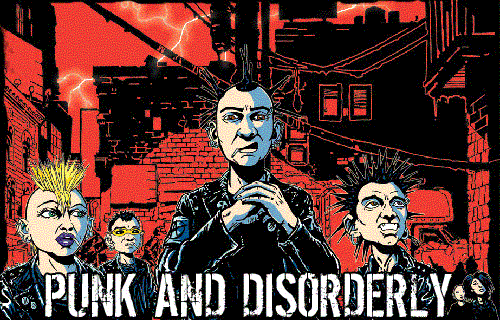
What is punk? In and of themselves, the words- punk rock, have completely lost their context. They're used to describe everything from a band that sells millions of records, playing to thousands of people to bands that slog out a month long tour playing in basements and coffee houses to fifteen people every night. The term is used to describe music, lifestyles, and even, political stances. The over-use and generalization has taken all the meaning and impact from those two, little words. It's not anything new. Before the British and American tabloids turned the Sex Pistols and punk rock into household names, the word "punk" was used to describe the music of a wide range of artists from The Stooges to Bruce Springsteen to Patti Smith. Punk hadn't become another label to slap on to a band's music. It hadn't become the definition for a youth counter culture. It wasn't a clear cut term then, and it certainly isn't today. Punk Rock is an ever evolving artistic notion. It flows over into the music that people make, the lifestyle they choose, the clothes they wear, and the attitudes they express to the world at large. It changes. It morphs itself into many different forms. But, there is one underlying notion that holds it all together. Individualism. Punk Rock is individualism in spite of the society and cultural conditioning that attempts to categorize everything, to make everything safe, and make everything homogenized and easy to swallow. It's not clothes or music or a lifestyle. But, at the same time, it is all those things. Punk Rock is the great contradiction. It's serious and comedic. It's stoic and irreverent. It's conscious and primeval. Punk Rock is the last great stand against the sameness that lurks through our society, infecting everyone and everything like a parasite of boredom. Punk or Poser? With the recent punk fashion explosion, you see a lot of posers. And it's understandable that you want to speak your mind to them, maybe even beat them up for selling out the subculture that you are part of, but sometimes we judge too fast. Lately, The real punks are the ones that not only dress or listen to punk music but are deeply into the whole scene, the ones that see it as a way of life, the perfect expression of their mixed feelings and thoughts but there's many that like to show of and call other punks posers, probably because they don't dress that way? i don't really know i just a lot of people just talk shit!. That’s what surprises me most about the punk culture: the hypocrisy. The entire premise of being punk is doing what you want, wearing what you want, and listening to what you want. The way I see it, it's not really about music or fashion, but a way of thought. It's all supposed to be all about freedom, i mean of course we can't call bands like blink182 or just pop bands PUNk cuz they are simply not punk at all, I'm my own personal opinion i can't even stand their music, it really annoys me, but my question is do we have to talk shit about a person that likes that kind of stuff? why not just mind our own business, for me a poser is someone that while trying so hard to be semething denies wut they really are, like as an example someone tres to look all cool just to fit in and starts doing drugs and drinking and shit like that just for other people to think you know wut this kid is cool, even thou is goes against their true beliefs, then that's definelly a poser, be yourself, express yourself to the fullest, why try to something you're not? well wutever this si just a thought shared to people we all got out own different minds..and we all work them diffenrent! |
 . |
|||
|
||||